
1. Execution Model
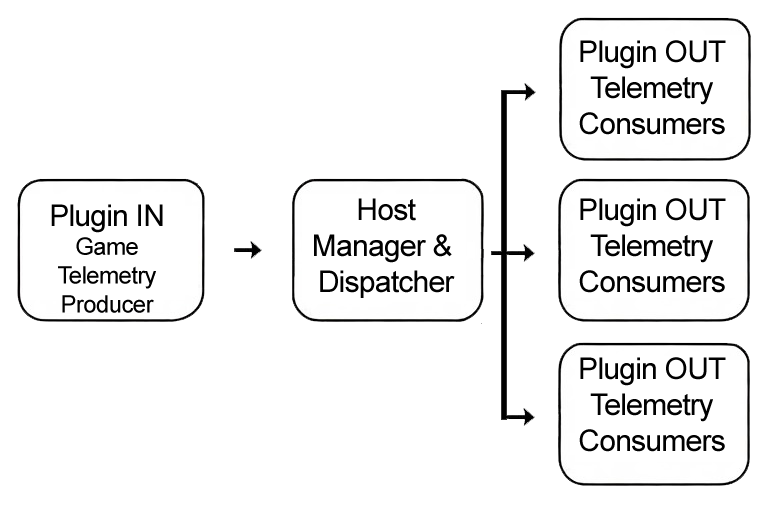
OpenSR is built around a host-driven plugin system with two distinct plugin categories:
- IN Plugins (Game plugins) → produce telemetry
- OUT Plugins (Device / Output plugins) → consume telemetry and produce inputs
These two categories are managed differently by the host.
Common Plugin Interface
#include <string>
#include <functional>
#include "OpenSRContext.h"

#define OpenSR_PLUGIN_API extern "C" __declspec(dllexport)

#define PLUGIN_TYPE_NONE -1
#define GAME_PLUGIN_TYPE 0
#define OUT_PLUGIN_TYPE 1

// Check if we are compiling with VS2010 (Ver 1600) or older
#if defined(_MSC_VER) && (_MSC_VER <= 1600)
    // VS2010: Does not support "= default"
    #define OSR_DTOR_BODY {}
    #define OSR_NOEXCEPT
#else
    // Modern VS (2015+): Use modern C++ standards
    #define OSR_DTOR_BODY = default;
    #define OSR_NOEXCEPT noexcept
#endif
namespace osr {
    enum OpenSRContextChange
    {
        ProfilePathChanged,
        SettingsChanged,
        FullContextReloaded,
        CheckDevice
    };


    class IOpenSRPlugin {
    public:
        virtual ~IOpenSRPlugin() OSR_DTOR_BODY

        // Called immediately after loading the DLL to provide setup and shared memory access
        virtual bool Init(OpenSRContext* context, void* buffers, const wchar_t* pluginPath) = 0;

        // Called to start processing. This should be a NON-BLOCKING call.
        // The plugin should start its work in a separate thread.
        virtual bool Start() = 0;

        // Called to request the plugin to pause its processing
        virtual void Pause() = 0;

        // Called to request the plugin to resume its processing
        virtual void Resume() = 0;

        // Returns true if the plugin's main processing loop is active.
        // This is used by the manager to detect if the plugin has terminated unexpectedly.
        virtual bool IsRunning() const = 0;

        // Called to request the plugin to stop its processing (join threads)
        virtual void Stop() = 0;

        // Called before unloading to cleanup
        virtual void Shutdown() = 0;

        // Returns generic pointer.
        // Host sees void*, Plugin UI casts it to SharedData* later.
        virtual uint64_t GetSharedPointer() {
            return 0;
        }

        // metadata
        virtual void GetPackageName(char* buffer, size_t bufferSize) const = 0;   // e.g. "com.author.outplugin.slipro" or "com.company.gameplugin.rfactor2"
        virtual void GetPluginName(char* buffer, size_t bufferSize) const = 0;
        virtual void GetAuthor(char* buffer, size_t bufferSize) const = 0;
        virtual void GetVersion(char* buffer, size_t bufferSize) const = 0;
        virtual void GetLicenseType(char* buffer, size_t bufferSize) const = 0;
        virtual void GetDescription(char* buffer, size_t bufferSize) const = 0;
        virtual void GetTargetName(char* buffer, size_t bufferSize) const = 0;
        virtual void GetTargetProcessName(char* buffer, size_t bufferSize) const = 0;

        virtual void GetPluginGroupName(wchar_t* buffer, size_t bufferSize) const = 0;

        virtual bool IsBackend() const { return false; }

        virtual int GetType() = 0;

        virtual bool IsCheckingAllowed() { return false; }

        virtual void CheckDevice() {}

        // reload notification
        virtual void OnContextChanged(osr::OpenSRContextChange reason)
        {
            // Default: do nothing
        }

        // Optional: Set UI TAB Name (Default 'Plugin')
        virtual void GetUITabName(char* buffer, size_t bufferSize) const
        {
            strncpy_s(buffer, bufferSize, "Plugin", _TRUNCATE);
        }

        // Optional: Set Settings TAB Name (Default 'Settings')
        virtual void GetSettingsTabName(char* buffer, size_t bufferSize) const
        {
            strncpy_s(buffer, bufferSize, "Settings", _TRUNCATE);
        }
    };

}

// Mandatory exported factory function for the loader
typedef osr::IOpenSRPlugin* (*CreatePluginFunc)();
typedef void (*DestroyPluginFunc)(osr::IOpenSRPlugin*);

OpenSR_PLUGIN_API osr::IOpenSRPlugin* CreatePlugin();
OpenSR_PLUGIN_API void DestroyPlugin(osr::IOpenSRPlugin* plugin);
2. OUT Plugins Lifecycle (Device / Output)
OUT plugins are fully managed at application level.
Lifecycle sequence:
- Load
- Init(…)
- Start()
- Runtime (plugin-owned thread loop)
- Stop()
- Shutdown()
- Destroy / Unload
Key characteristics:
- Always loaded when OpenSR starts (unless disabled)
- Run independently of any game
- Responsible for:
- Their own thread loop
- Writing input data (InSimData)
- Reading telemetry data (OutSimData)
There is no central loop for OUT plugins — they are autonomous once started.
3. IN Plugins Lifecycle (Game Plugins)
IN plugins are managed dynamically by the Game Manager.
Host behavior:
- All IN plugins are loaded at startup
- A central Game Manager loop continuously:
- Monitors running processes
- Matches them against plugin target executables
Lifecycle sequence (per game detection):
- Init(…)
- Start()
- Runtime (plugin-owned thread loop)
- Game exits →
- Stop()
- Shutdown()
Key characteristics:
- Only active when their target game process is running
- Must implement:
- Game detection via
GetTargetProcessName
- Game detection via
IsRunning()is actively checked by the host to ensure health
4. Threading Model
- All plugins (IN and OUT) are expected to:
- Spawn and manage their own worker thread(s)
- Start threads in
Start() - Stop them cleanly in
Stop()
- The host:
- Does not execute plugin logic loops
- Only orchestrates lifecycle and data exchange
5. Data Flow Architecture
Core principle:
IN → Host → OUT
Step-by-step flow:
1. IN Plugin (Game)
- Writes telemetry into:
OutSimData- Optional
BlobData
- Calls:
submitFrameCallback(userData);
2. Host Processing
- Receives frame submission
- Validates data
- Adds internal metadata (e.g., frame ID)
- Dispatches data to all active OUT plugins
3. OUT Plugins
- Read from:
OutSimDataBlobData
- If applicable (device plugins):
- Write into:
InSimData(inputs: buttons, axes, etc.)
- Write into:
4. Input Propagation
- Host monitors
InSimData - When input changes:
- Broadcasts updates to all OUT plugins
6. Shared Buffers Model
IN Plugins access:
OpenSRBuffersIN
- OutSimData*   // write telemetry
- BlobData*     // optional custom data
OUT Plugins access:
OpenSRBuffersOUT
- InSimData*    // write inputs
- OutSimData*   // read telemetry
- BlobData*     // read custom data
7. OpenSRContext Role
The context provides:
- Application state:
isAppRunningtargetGamePId
- Paths:
- App folder
- Documents folder
- Current profile
- Frame submission:
void (*submitFrameCallback)(void* userData);
This is the only synchronization point between IN plugins and the host.
8. Central Loop Behavior
- Present:
- Game detection (IN plugins)
- Input monitoring (InSimData)
- Not present:
- OUT plugin execution (fully autonomous)
9. Game Detection Logic
- Each IN plugin defines:
GetTargetProcessName() - Host:
- Scans running processes
- Starts plugin when match is found
- Stops plugin when process exits
10. Pause / Resume Mechanism
The host provides a global kill switch:
Pause()→ plugins must suspend activityResume()→ plugins resume execution
Requirement:
All plugins are expected to:
- Implement pause-safe thread behavior
- Avoid busy loops during pause
11. Disabled Plugins
- Completely excluded from:
- Loading
- Lifecycle execution
- Data flow
Disable unused plugins (recommended).
Resulting Model
- Host = orchestrator + router
- IN plugins = telemetry producers (event-driven via callback)
- OUT plugins = consumers + input producers (continuous loops)